

Our corporate sustainability strategy ensures the health and safety of employees and contractors, promotes gender equality, optimizes water use, improves energy efficiency and reduces emissions.
Each objective has specific indicators and targets, which are constantly measured and reported annually. The company establishes them according to the local reality, with a global vision to support its clients in improving their ESG performance, using the IFC performance standards as a standard for sustainability and socio-environmental risk management.
For AGUNSA, sustainability is a core value that allows us to manage the relationship with the stakeholders adequately by way of a transparent and regular dialogue to maintain mutual trust and clear understanding.
At AGUNSA, the environment, social and corporate governance pillars are addressed in the following dimensions.


The sustainability strategy is built on 5 pillars, from which we address the challenges of the sustainable development objectives.
| HEALTH AND SAFETY | GENDER | WATER EFFICIENCY | ENERGY EFFICIENCY | EMISSIONS |
|---|---|---|---|---|
|
Health and Wellbeing

|
Gender Equality
.svg)
|
Clean water and sanitation
.svg)
|
accessible and non-polluting energy
.svg)
|
Industry, Innovation and infrastructure
.svg)
|
|
3.6.1
Frequency Index |
5.5.2
Proportion of women in positions such as: Managements,Assistant Managements and Headships |
6.3.1
Proportion of wastewater treated adequately |
7.2.1
Proportion of renewable energy in total general consumed energy |
9.4.1
CO2 emissions per unit of added value |
|
3.6.2
Severity rate |
||||
|
Responsible production and consumption
.svg)
|
Climate Action
.svg)
|
|||
|
12.2.1
Water footprint |
13.2.1
Establishment of Corporate Policy for Climate Change |
At AGUNSA, we continuously measure the progress of each pillar and in their related SDG we disclose these results annually in our sustainability reports
| ODS | Specific objective | KPI | 2022 | 2023 | 2024 | |
|---|---|---|---|---|---|---|
|
HEALTH AND SAFETY
|
Health and Wellness
|
3.6.1
Frequency index |
Number of accidents per hours worked. | 0 | 0 | 0 |
|
3.6.2
Severity rate |
Number of days lost per hours worked. | 0 | 0 | 0 | ||
|
GENDER
|
Gender Equality
|
5.5.2
Proportion of women in positions such as: Managers, Assistant Managers and Heads of Department |
Increase the female participation in senior executive positions by 2025 reaching 27.5% in Chile. | 21% | 23.1% | 31% |
|
WATER EFFICIENCY
|
Clean water and sanitation
Responsible production and consumption
|
6.3.1
Proportion of wastewater treated adequately |
M3 of LIW generated/m3 of LIW treated. | 88% | 100% | 100% |
|
12.2.1
Water footprint |
Reduce total potable water consumption by 16% in 2025 in relation to the total consumed in 2021 in Chile. | Consumption increase by 10.7%. | A 19.5% reduction in drinking water consumption compared to 2022. | 49.550 m3 | ||
|
ENERGY EFFICIENCY
|
affordable and non-polluting energy
|
7.2.1
Proportion of renewable energy in the general total of energy consumed |
KWH of renewable sources/Total KHW. | 26% | 51% | 61% |
|
EMISSIONS
|
Industry, Innovation and Infrastructure
Climate action
|
9.4.1
CO2 emissions per unit of added value |
Tons of equivalent CO2 per monetary income. | 6,42 ton CO2/10.000 USD. | 6,01 ton CO2/10.000 USD. | 2,96% ton CO2/1.000.000 USD |
|
13.2.1
Establishment of Corporate Policy for Climate Change |
Establish Policy of Climate Change and its due compliance. | Adjustments in the environment assessment for the supplier selection process: - Creation of Procurement Policy under construction. - Selection of indicators in initial stage. | Strategy of Efficiency of Resources and Methodology to Estimate the Greenhouse Gases that boosts the efficiency of all the resources including: - Energy efficiency. - Water efficiency. - Generation of waste. - Estimation of greenhouse gases. | Implementation of strategies, monitoring and control of results. |
Quality is a fundamental commitment that guides the provision of our services, driving operational excellence, continuous improvement and compliance with applicable customer, regulatory and legal requirements. Through efficient management, ongoing communication with our stakeholders and the development of our employees' skills, the organization seeks to ensure high service standards, strengthen customer satisfaction and generate sustainable value.
Occupational health and safety is a fundamental value that guides the development of our activities, promoting a preventive culture based on risk management, people's wellbeing and an ongoing commitment to continuous improvement, safeguarding safe and healthy working conditions for our employees, contractors and suppliers.

AGUNSA declares the “commitment to respecting communities by developing a proactive management and promoting and fostering a culture of sustainable community relationships among our collaborators.
The company sets these objectives according to local realities, while maintaining a global perspective and focusing on supporting its clients in improving their ESG performance. We also use the IFC (World Bank) performance rules as our own standard for the development of sustainability and risk management of identified socio-environment risk management.
At AGUNSA, we declare our commitment to the respect of communities developing a proactive management
At AGUNSA, we guide our community relationships with respect and the aim of establishing long-term relationships. To achieve this, we have 8 specific procedures that address the company’s social and territorial risk management.
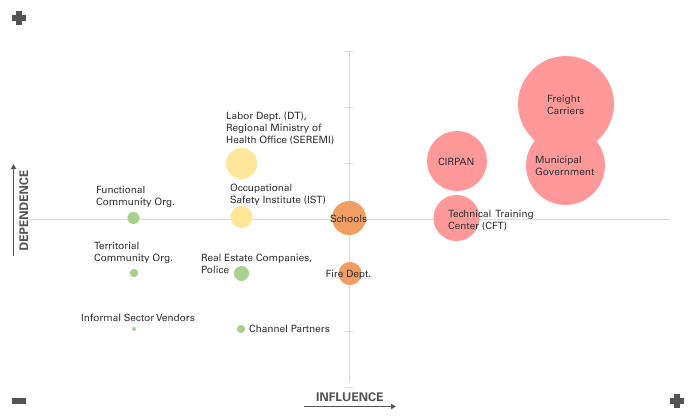
The company updated its Stakeholders Maps annually to:
AGUNSA acknowledges the impact of their operations on the environment; for this reason, the identified impacts are assessed and, according to the results, measures are proposed and implemented to control and mitigate them. The company has an environmental policy and a climate change strategy that serve as guidelines for the specific procedure programs in the matter.

Since 2018, our Environmental and Sustainability Policy has guided responsible actions across all our areas. We have 5 strategic pillars: Safety, water efficiency and reduction of emissions. We work to reduce our environmental impact and improve gender equality. We continue strengthening our commitment to communities and occupational safety, reflecting a culture of closeness and empathy in each step we take.

.jpg)
.jpg)

 ISO 45001